HQ
← All stories
Setup · 7 min read

How to turn an old iPad into a family calendar display.

Skylight charges $299–$379 for what is, essentially, a 10–15" Android tablet running their app. If you already own an iPad, you have nicer hardware sitting in a drawer. Here's the 10-minute setup that replaces the dedicated display, and the three settings that make an iPad behave like an always-on family screen.

Tej Tandon
Founder, HomeHQ
The short answer

Any iPad from 2018 or later — including the cheap base model and any iPad mini — is more than capable of running as an always-on family calendar display. The Retina screen is sharper and more color-accurate than any dedicated calendar display, and iPadOS keeps getting security updates for seven-plus years.

The reason most people don't do this isn't technical. It's that nobody tells you the three settings to change for an iPad to behave like a dedicated display: Auto-Lock off, a brightness automation, and a single app pinned to the screen. Once those are set, the iPad does everything a dedicated display does, except the $299 price tag — worst case you're out $25 for a stand.

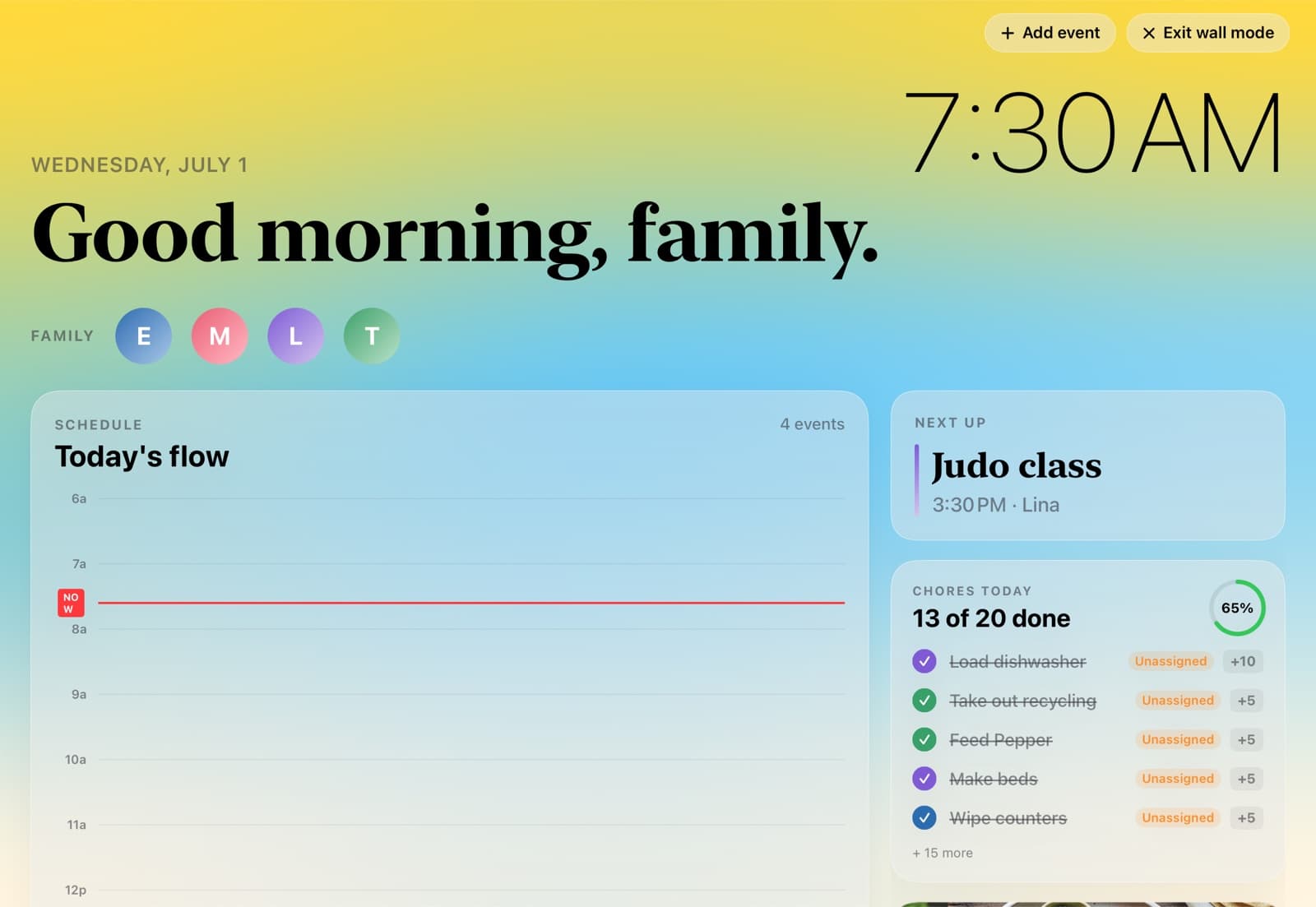
HomeHQ running as an always-on family calendar display on a wall-mounted iPad

The finished setup — a real capture, not a mockup.

Step by step

How to do it.

1

Pick the iPad.

Any iPad from 2018 onwards works. The base iPad, iPad Air, iPad Pro, and iPad mini are all fine. You want the screen to be 9.7" or larger if you can — a mini works but you'll squint at it from across the kitchen.

A newer model gets you a brighter screen and more years of updates, but it isn't required. The screen is the whole point here: big enough to read from across the kitchen while someone's cooking with wet hands.

No iPad? A used 2020 iPad (8th gen) sells refurbished for around $130 on Apple's certified refurb store and Back Market.
2

Mount it somewhere visible.

Three options, in order of cost. (1) Kitchen-counter stand — $25–$60 on Amazon, no installation, easy to take down for video calls. Search "iPad kitchen stand" and pick anything with a 4+ star rating and an adjustable angle. (2) Under-cabinet swing-arm — $30–$50, screws into the underside of a cabinet, flips down when you want it and up when you don't. (3) Wall mount — $30–$120, looks the most permanent, requires drilling. The Belkin TabletPlus or any VESA-compatible iPad case works.

Whichever you pick, plug it in via a long Lightning or USB-C cable run along the back of the counter. An iPad displaying a calendar will burn through battery in 6–8 hours; you want it plugged in continuously.

3

Set Auto-Lock to Never.

This is the most important setting. Open Settings → Display & Brightness → Auto-Lock → Never. The iPad will now stay awake as long as it has power. Without this, every time someone walks past the kitchen the screen is dark.

You can also dim the brightness manually overnight or set up an Automation (Settings → Shortcuts → Personal Automation) to drop brightness to 5% between 10 PM and 7 AM. Tiny touch, makes a huge difference in a kitchen at midnight.

4

Choose the calendar app.

The app determines the experience. Three realistic choices: (1) Google Calendar — free, syncs everywhere, but the iPad app is a phone app at heart and looks wrong on a big screen. (2) Cozi — built for families, but since 2024 the free tier only shows 30 days of calendar. (3) HomeHQ — built specifically for the kitchen-iPad use case, with per-person color coding, two-way Google Calendar sync, chore rotation with points, and meal planning.

Whichever you pick, the mount and settings are the same either way; the app just decides what fills the screen.

5

Pin a single app to the screen.

You don't want family members accidentally swiping into Safari or seeing your work emails. Use Guided Access (Settings → Accessibility → Guided Access → On) to lock the iPad to a single app. Triple-click the side button while the calendar app is open to start a session.

For an even stronger lock, set Screen Time → Always Allowed and restrict everything except your chosen family-calendar app. That way the iPad reboots back into the calendar even after an update.

Guided Access works on every iPad ever made. It's the closest thing iPadOS has to a kiosk mode, and it's been there since 2012 — Apple just doesn't advertise it.
6

Add family members and color-code them.

The biggest upgrade from "a calendar on a screen" to a display the family really uses is per-person color coding. Once events inherit their owner's color automatically, anyone can read the week from across the kitchen without stopping to squint.

In Google Calendar you do this by creating one calendar per person and assigning each its own color. In HomeHQ it happens automatically when you add a family member. If you want to go deeper on picking the palette, we wrote a full guide.

Read the full color-coding guide →
7

Run the 6 PM test.

The real test of a family calendar display: at 6 PM on a Tuesday, can anyone walk past it and answer "what's happening tomorrow?" in under five seconds? If yes, the system works. If no — usually the issue is that the week view isn't pinned by default, or the text is too small to read from 4 feet away.

Most family calendar apps let you set a default view. Pick the week view (5 or 7 days), font size large, weekend included. Then leave the iPad alone for a week and see whether people start using it on their own.

Tips and gotchas

A few things that'll save you time.

  • !Don't use a 2017-or-older iPad. They're too slow for always-on use and the battery has usually swollen from heat, which is a fire risk near a kitchen.
  • !Turn on a Focus (Settings → Focus → Do Not Disturb, scheduled around the clock) so notification banners from other apps don't sit on top of the calendar.
  • !Run iPadOS Stage Manager if you have an M-series iPad — you can pin the family calendar in one window and a small clock/weather widget in another. Looks great, no extra app needed.
  • !Because everything runs on your Google Calendar, anyone in the family who wears an Apple Watch still sees the day's events on their wrist through the built-in Calendar app. The kitchen iPad is the shared "source of truth"; the Watch is the personal mirror.
  • !For privacy, don't mount the iPad facing a window or front door. Calendar events show full text by default — anyone walking past from outside can read your kids' schedules.
  • !A 5W or 10W USB charger is enough — you don't need a fast charger. Slower charging runs cooler and extends battery health, which matters when the iPad is plugged in 24/7.
The kitchen-iPad family hub

HomeHQ is built specifically for this setup.

Per-person color coding, always-on display mode, two-way Google Calendar + Tasks sync, chores and meal planning, and a calm interface designed to be read from across a kitchen. Snap a photo of a school flyer and the events add themselves. $12/month billed annually for the whole family, 30-day free trial, no hardware to buy.

See HomeHQ →
Common questions

Questions families ask.

Any iPad from 2018 onwards works fine. A newer iPad gets you a brighter screen and more years of OS updates, but it isn't required for a great always-on family display. A used or refurbished iPad starts around $130.

Open Settings → Display & Brightness → Auto-Lock → Never, then plug it into a charger continuously. The iPad will stay on indefinitely. Optionally, set up a Shortcuts automation to dim the brightness overnight so it's not glaring at 2 AM.

Use Guided Access. Settings → Accessibility → Guided Access → On. Open the family calendar app, then triple-click the side button. The iPad will refuse to leave that app until you triple-click again and enter a passcode. Works on every iPad ever made.

Functionally, yes — the iPad is a sharper screen with more apps and seven-plus years of OS updates. The trade-off is mounting: a Skylight ships ready to drop on a counter, an iPad requires a $25–$120 stand or wall mount. If you don't already own an iPad and don't want to source one, the Skylight's "out of the box" experience may still be worth $299. If you do, an iPad is a clear upgrade.

It depends on your household. For families that want per-person color coding, chore tracking with points, and meal planning in one app built on the Google Calendar they already use, HomeHQ is built specifically for this. For households that want the most established name, Cozi has been around the longest, though its free tier now only shows a 30-day window. For minimalist setups, Google Calendar is free and serviceable, but it does not handle chores or meals.

Modern iPads (2018+) are designed to run safely for years plugged in. The main precautions: use a 5W or 10W charger (not a fast charger — slower charging runs cooler), keep the iPad in a ventilated stand (not enclosed in a case with no airflow), and don't mount it next to a heat source like a stove. Battery health degrades faster on always-on iPads — expect to replace the battery or the iPad after 3–5 years.

Tej Tandon
Founder, HomeHQ. Building HomeHQ from Vancouver — bootstrapped, no investors. I write these guides from running my own family on the same tools.
Keep reading
Ready when you are

Bring the calm home.

30 days free. Then $12/mo billed annually, or $14.99/mo. Your whole household, on the iPad and iPhone you already own.